Tuesday, 30 April 2013

iOS 7 Rumor Roundup

The usually overflowing well of Apple rumors has been oddly quiet when it comes to iOS 7. We have heard a few whispers here and there around development, but we’re in the dark as far as what specific features will make it to the finished product. It would seem that Jony Ive is a much better secret keeper than previous iOS helmer Scott Forstall. With a new version of the OS scheduled to debut in June, it’s high time we try and figure out what might be coming, and what we want from, the next iOS.

A flattened, less skeumorphic design
 rumor roundup apple ios 7 podcasts app screenshotOne of the first things that happened under Ive’s new leadership of iOS was a refresh of the almost universally reviled Podcasts app. It received a number of fixes and new features like iCloud-synced stations that can download new episodes automatically, as well as support for on-the-go playlists. The biggest change, however, was a visual one. The faux-tape deck and large, square buttons were trashed for a more cohesive design that was easier to navigate.
If the revamped Podcasts app is any indication, and it is, then we can expect to see a lot more of this across iOS 7. We wouldn’t be surprised if the Games Center app had the carpet ripped up and icons were generally flattened and made more iconic and less … shiny. Whatever he’s doing behind closed doors, Ive’s seems to be making an impression. Rene Ritchie of iMore said in a recent Branch chat that Ive’s work is “apparently making many people really happy, but will also apparently make rich-texture-loving designers sad.”

What we want from iOS 7


Much to my surprise as a Windows Phone / Android user, Apple still hasn’t mastered the art of background tasks. It can consistently throw you back into an app exactly where you left off, but that means the app usually does nothing while you were away. It’s simply frozen and unfrozen. Currently, apps like Spotify, and yes, even the new Podcasts app, need to be open to download new content. So the automatic download feature in the Podcasts app essentially just means new episodes begin downloading as soon as you open the app.

We’d like to see this fixed in iOS 7, with a nice mix of Android’s free-for-all task management and Windows Phone’s tightly managed, battery-savvy multi-tasking. Actually, it doesn’t even matter how Apple does it, as long as Spotify can sync without anyone looking at it. It’s not just media that’s affected either, the issue branches out into email (the Gmail app sends notifications, but doesn’t actually sync until you open it and refresh) and other areas.

“Notifications are still terrible.”
rumor roundup apple ios 7 mailbox app screenshot
As a whole, notifications feel a bit like a feature thrown in as a crowd pleaser that Apple couldn’t care less about. Android is ruling the roost in this department with 4.2.2 bringing actionable notifications, meaning you can choose to read or reply to text messages right from the drop-down menu, among other tasks. Apple users want that; everybody wants that. Notifications are one of the most difficult things to manage on a smartphone and they need all the help they can get. Making them swipeable would be a great first step; a more swipeable interface in general would help iOS a lot actually.
The swipe-happy Mailbox app is a good example of the demand for it on iOS, with a long line of people signing up to access the beta. The tiny X that currently only deletes notifications in batches (all emails or none of them) is no longer sufficient. Finally, the alert system could use an overhaul as well. It’s funny that Apple has yet to recognize the usefulness of an LED indicator. All Android phones have one. The current system of completely turning the screen on not once, but two times (assuming you don’t cliick on it first) is barbaric and wasteful of precious battery juice.

“iOS needs a visual overhaul.”
We covered this up top in the rumor section, but it bears repeating. Apple’s software is getting tired and it’s being left in the dust as Windows Phone continues to get more attractive and Android keeps getting more powerful. Part of that will happen with Ive’s enforcement of a more cohesive user experience that relies less on gradients and textures, but it needs to go further than that. User experience isn’t judged solely on the software’s look; it’s also based on ease of use. A unified way of handling settings would be a good first step. Currently, a random assortment of app settings are handled in-app with others accessed in the stand-alone Settings app.
Furthermore, we’d like to be able to use the apps we want to use, not the ones Apple is pushing. (And maybe Apple’s apps could be improved?) Most of the built-in apps on iOS suck, not just the mapping system. If someone wants to uninstall the built-in Weather app for instance, and replace it with the Weather Network app then that should be able to happen. And we’re just going to say it, if iOS 7 brought support for widgets – both on the lockscreen and the homescreen – we wouldn’t be upset. We might even be excited.
 

Genius Gila GX Review


gx gila gaming mouse rear right

Highs
  • 8200 DPI sensor
  • Solid build quality
  • Useful driver software
  • Good value
Lows
  • Difficult button placement
  • Ergonomics could be better

You probably haven’t heard the name Genius much in the world of gaming peripherals. Though not a new company, Genius has never been well known in North America and is just now making a serious push into the gaming market. Genius joins companies like Corsair and Cooler Master in challenging veterans such as Logitech, Razer, and MadCatz, and giving gamers more choice than ever before.
Genius, aware of the war waged for gamer’s hearts and wallets, has crafted a focused peripheral that makes no apologies and cuts no corners. Everything we could want is here, including a high-DPI sensor, on-the-fly sensitivity adjustment, numerous buttons with macro support, slick LED lighting, and even built-in memory that stores your settings (so you don’t have to re-adjust the mouse when you plug it in to a different PC). The insane feature set earned the mouse a CES Design And Engineering Award at CES 2013.
Even more impressive is the price. Though the MSRP is $100, which would be fair for a mouse with these features, the Gila GX can be purchased through Amazon for close to $75, and can be found on sale at other retailers for even less. Let’s see if Genius can compete with gaming’s old guard.

gx gila gaming mouse frontgx gila gaming mouse rgb backlight system macro

Tuesday, 23 April 2013

Celkon HD A119 Siganture: Review

Celkon Signature HD A119
pros
  • Good display
  • Camera
  • Battery life
cons
  • Just a dual core processor
  • Costly for a dual core phone from Indian brand
Celkon is not a very well known brand in North India but down South it has managed to penetrate the market, and it has now begun expanding to the north as well. Celkon Signature HD A119 is the first handset from Celkon that we are reviewing and on the face of it the device looks powerful.

The 5 inch phone comes with an HD display and 12 megapixel camera at the back and is based on Android 4.1, but unlike its competition with a similar sounding name, Micromax Canvas HD A116 gets only a 1 GHz dual core processor (Canvas HD gets a 1.2 GHz quad core processor). But in the rest of the specifications it actually matches or betters the Canvas HD A116. But how is it in the real world? Here is what we think of it after using it extensively.

Design 
The phone is a damn good looking piece of electronics. The front portion is glass covered and surrounded by a glossy black frame followed by a grey aluminum finish surrounding and then a metal finish back, though made of very thin but durable looking plastic.

The 12 megapixel camera unit protrudes from the back, but the glass is sunk slightly into the housing, protecting it from scratches. The camera unit is protected by a metal surrounding. It only has a regular port and the placement is usual but neat. Both a 3.5 mm jack and a USB port are on top. Removing the back cover reveals the two SIM slots placed side by side and a micro SD card slot all accessible without removing the battery. The power/lock button is on top and volume rocker is on the left.
The phone has a very narrow bezel around the display, which has kept the overall dimension of the phone very handy with a width of 74.5 mm and length of 148 mm. It's also very slim with a thickness of 9.3 mm.

Display 
Celkon Signature HD A116 has a 5 inch IPS panel display with 1280 x 720 pixel resolution, which is what Micromax Canvas HD A116 offers. It is in itself a great looking display. There is no pixelation and the viewing angle is great too.

Camera 
Celkon has put a 12 megapixel camera at the back and a 3 megapixel unit in front. Fortunately, unlike other Indian brands with tall claims of 8 megapixel delivering nothing better than 3-4 megapixel performance, this 12 megapixel autofocus camera does perform quite well. We even clicked pictures of documents and the text was crisp and clear. The colour and sharpness of images is really well recreated with just the right amount of saturation. There are no overly bright and colorful images, which many cameras do to make the image look better.

Performance 
Though the Celkon Signature HD A119 gets only a 1 GHz dual core processor, it is coupled with a healthy 1 GB of RAM and 4 GB of ROM (1.45 GB available for users). With a 1 GHz dual core processor we were not expecting a powerhouse of performance, and it is indeed not one either.

However, thanks to Android 4.1 Jelly Bean operating system, which is optimised for performance by Google through Project Butter, the phone performs smoothly. It does not offer really fast frame rates in games but it plays them without freezing.

Battery 
The phone gets a 2100 mAh battery, which offers almost two days of backup with low to medium usage, which is better than average for an Android handset in this range.

Celkon Signature HD A119OS and user interface 
Android 4.1 Jelly Bean operating system in this phone is more or less stock and there is very little that Celkon has tweaked, which is not too bad since stock Android 4.1 is really a well laid out operating system. Most of Celkon's contribution is limited to adding a few pre loaded apps like Newshunt (news aggregation

app), My Mango TV app etc.


Celkon Signature HD A119 Verdict 
Celkon Signature HD A119 is priced at Rs 13,500. As such it is priced about Rs 2,000 above other 5 inch dual core processor phones, and in fact is even costlier than Karbonn Titanium S5, which has a quad core processor. However, given that it has a great display, it is well designed with a nice quality feel to it and also gets one of the best cameras in this range. It is well worth the price. The performance of the phone is also good enough for most applications.

 Celkon is already a known brand at least in South India and according to some reports it is number five in terms of sales volumes across India, and therefore brand image will not be a problem for this phone. One thing that works in favour of Celkon and for which the company is in no way responsible is the increased price of Micromax Canvas HD A116, which is one of the toughest competitors for this phone, but it is at least Rs 2,000 costlier.

Celkon Signature HD A119: Review Specifications
Network GSM -900 MHz, 1800 MHz; UMTS - 2100
Operating System Android 4.1 Jelly Bean
Dimensions 148 x 74.5 x 9.3 mm , 177 grams
Display 5.0 inches, 1280 x 720 pixel
Input Method Touchscreen
Processor 1 GHz dual dual core
Memory 1 GB RAM, ROM 4 GB
Connectivity 3G, WiFi, Bluetooth
Multimedia Supports all major audio file types
Camera 12 megapixel auto focus, 3 megapixel in front
GPS Yes
Additional features In built user usable 4 GB, expandable 32 GB
Battery 2100 mAh
Warranty 1 year
Price Rs 13,490
--------------------------------------------------------------------------------------------------

Monday, 22 April 2013

Which smartphones and tablets are the greenest?

 
Awareness about the negative impact we are having on the planet has been growing in recent years. Big business and conspicuous consumption has contributed to pollution in the air and water, the production of toxic chemicals and waste, and dangerous working conditions for many workers. Climate change is undoubtedly having an impact on our planet. What can you do if you want to enjoy the latest smartphones and tablets, but minimize the potential harm caused in their production and use?
 

What does eco-friendly or green really mean?

The first obstacle you run into when you try to figure out whether a tablet or smartphone has green credentials is the complete lack of a consensus on what green or eco-friendly actually encompasses. Are we talking about the entire lifecycle of a product? There’s a lot to consider, and this is by no means an exhaustive list, but here are some questions to ask:
  • What materials are used?
  • Where did the materials come from?
  • How was the product manufactured with regard to worker conditions and pay, energy usage, and pollution?
  • Where did the packaging come from and how was it made?
  • How energy efficient is the device?
  • How easy is it to recycle and what waste products will it leave behind at the end of its life?
You may also want to consider whether the companies selling these devices are committed to eco-friendly practices at corporate level. Do they use clean energy, source sustainable supplies (like paper), and recycle at their offices? Do they have schemes to recycle or repurpose their products and extend the life cycle? Do they take part in any eco-friendly initiatives or voluntarily register for green assessment?

Independent assessment

If you ask a company how green they are, then they’ll always put their best side forward. If you want to get a realistic picture of their commitment, then you have to turn to independent assessors.
Ethical Consumer: For a really detailed breakdown of environmental and ethical considerations, you should check out the Ethical Consumer website. It has a comprehensive guide covering most of the top manufacturers, and rates them out of 20, providing links to stories related to various aspects of their business from environmental reporting, to workers’ rights, to political activities. You can use the slider controls to dictate what is important to you and customize the score, but you have to subscribe to get full access to the data.
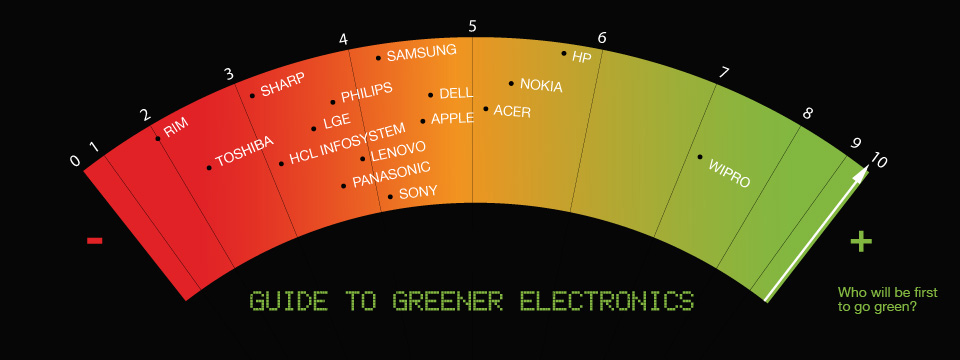
Guide to Greener Electronics: You could also check out the Guide to Greener Electronics, published annually by Greenpeace. It focuses on three areas to determine a company’s score out of 10: energy and climate, greener products, and sustainable operations. You can find a detailed breakdown of the criteria used via the link above.
EPEAT: Then there’s the EPEAT register which is billed as “The definitive global registry for greener electronics.” It made headlines when Apple revealed it was dropping EPEAT certification and then reversed the decision after complaints from loyal customers. Sadly, EPEAT does not yet cover smartphones.

Green guides from wireless carriers

Virtually all carriers offer refurbished devices and/or trade-in programs. Most of them have recycling schemes in place, but some go a little bit further.
AT&T EcoSpace: AT&T has something called EcoSpace where the company highlights its eco-friendly side. It also has an eco-rating system for smartphones that gives each handset a score out of five, based on five criteria. For the record, the only two phones with five stars ratings right now are the Samsung Galaxy Exhilarate and the Samsung Galaxy Rugby Pro.
Sprint eco-criteria: Sprint also has its own eco-criteria for products, which also gives products a rating out of five, but is based on six criteria. The Samsung Replenish and LG Viper appear to be their highest rated eco-friendly phones with scores of four out of five.
Verizon Sustainability: Verizon has a Sustainability page where it highlights various recycling and donation schemes for old handsets and also highlights what it does as a company to be greener.

Who is the greenest of them all?

Figuring out the greenest manufacturer for you really depends on exactly what criteria are important to you and who you trust. It’s worth mentioning that many of the assessment schemes are voluntary. Apple doesn’t participate in any of the carrier rating schemes, preferring to publish its own guide to Apple and the Environment.
An Indian company called Wipro tops the Greenpeace list with 7.1 out of 10, followed by HP with a score of 5.7. Nokia, in third, is the best-placed smartphone manufacturer on the list with a score of 5.4 out of 10. Apple scores 4.5 and Samsung scores 4.2.
If we just look at the environment and product sustainability at Ethical Consumer then Nokia comes top again with a score of 12 out of 20. Motorola also scores 12 out of 20; HTC and Sony score 10; Apple and Samsung are both on 8 out of 10.
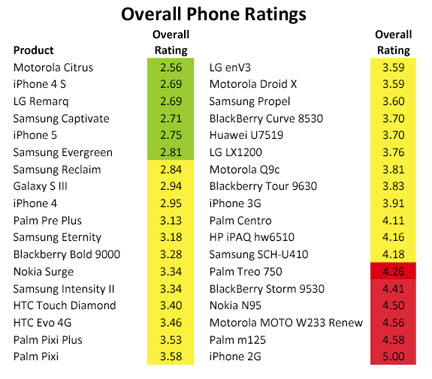
Obviously, the criteria you use changes the rankings significantly. If you were just to look at the use of hazardous materials in phone manufacturing, like Healthy Stuff did, then you’d get a chart like this (the lower the number, the less hazardous materials and chemicals were used).

 
 Healthy_Stuff_Phone_Ratings


Saturday, 20 April 2013

Google ‘to release in-house music streaming system this year’

Google will reportedly unveil a home entertainment system that streams music wirelessly later this year, marking the first time the search giant has developed consumer electronic devices under its own name.

 Google, Apple

Sources within the company told the Wall Street Journal that the unnamed device had been in development for several years and could be the first product to derive from the Project Tungsten system demonstrated last May.
The speculated product represents an escalation of Google’s ongoing competition with Apple.
Google’s Android operating system, which powers smartphones, tablets and televisions, is already reported to have overtaken the iPhone in market share last year.
Its pending purchase of Motorola Mobility Holdings is a clear sign of Google’s hardware intentions, while Apple moved into Google’s search territory with its voice-activated Siri service.
In addition, Google has been readying its own physical retail presence after previously only dealing with digital sales.
Google’s rumoured wireless music-streaming home entertainment system also represents a clear challenge to Apple’s AirPlay and Sonos.
A Google spokesman declined to comment to the Wall Street Journal on the rumours, while the Daily Telegraph said the product was unlikely to debut at the forthcoming Mobile World Congress in Barcelona.